


Brain Oscillatory Tensegrity – A Multidimensional Perspective on EEG and Self-Regulation
Bill Brubaker, M.Ed., M.Psych. , BCN, QEEG-D — Stress Therapy Solutions, Inc.
Thomas F. Collura, Ph.D., MSMHC, QEEG-D, BCN, LPCC-S — Founder & President, BrainMaster Technologies, Inc.
BrainMaster Technologies — Perspectives in Neurofeedback — 2026
How Buckminster Fuller’s architectural insight illuminates the dynamic balance of brainwave rhythms — and what it means for neurofeedback practice.
We have spent our careers asking what it truly means for the brain to be in balance. We speak casually of “brainwave balance,” of restoring the right proportions of alpha and beta, of calming an over-activated frontal lobe or reviving a sluggish one. But behind all of those clinical observations there must be a deeper structural logic — a reason why balance is not just desirable but, in a very precise sense, load-bearing.
We believe that framework now has a name: brain oscillatory tensegrity.
The term brings together two ideas that at first seem unrelated. Tensegrity is an architectural principle introduced by Buckminster Fuller, describing structures whose integrity depends not on rigid joints but on a pre-stressed interplay of tension and compression distributed continuously across the whole. The neural oscillations — the delta, theta, alpha, beta, and gamma rhythms that have defined our field since Hans Berger — are the brain’s temporal counterpart to that architecture. Together, they suggest that the stability of conscious, adaptive cognition is not located in any node, not stored in any single region, but is held in the dynamic, distributed balance of oscillatory phase relationships across time.
“Stability maintained through a pre-stressed balance of phase-locked and phase-dispersed oscillatory relationships, with information distributed omnidirectionally through the phase structure — this is oscillatory tensegrity in its most precise form.”
— Collura & Brubaker
The Architecture of the Idea
From space to time: Fuller’s gift to neuroscience
Fuller’s tensegrity structures have always fascinated us because they do something remarkable: they separate the work of compression from the work of tension and assign those roles to different structural elements. The compression struts float in space, each isolated from every other, held in position entirely by the continuous web of tension cables that surrounds them. There are no direct strut-to-strut connections. This means that any force applied anywhere in the structure is instantly distributed everywhere — the system as a whole stiffens in response rather than buckling locally.
The parallel in biology was identified by Donald Ingber, who showed that the cytoskeleton of living cells operates on exactly these principles. Microtubules act as compression struts; actin filaments provide the continuous tension network. The result is a cell that is mechanically resilient, structurally adaptive, and capable of transmitting mechanical signals throughout its volume instantaneously.
What we propose here is that the brain extends this same logic into the time domain. Instead of compression and tension being distributed in space, they are distributed in time, across the hierarchy of neural oscillations.
The temporal structure
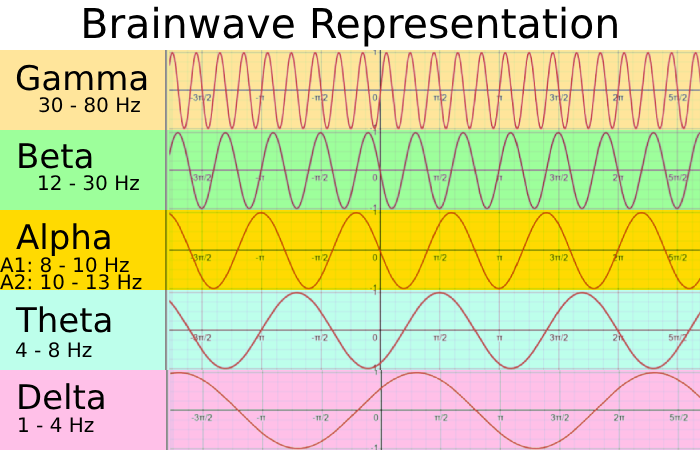
Slow oscillations — theta and alpha rhythms in the 4–12 Hz range — function as the continuous tension network. They are always present, widely distributed, and they set the scaffolding within which faster activity is organized. Fast bursts of gamma oscillation (30–80 Hz and above) function as the compression struts: localized, episodic, powerful, but not connected directly to one another. They arise and subside within the slow-rhythm windows that make space for them.
The coupling between these two layers — what neuroscientists call phase-amplitude coupling, or theta-gamma coupling in particular — is the precise temporal equivalent of a tensegrity joint. The phase of the slow rhythm modulates the amplitude of the fast rhythm, creating a hierarchical scaffolding in time. Working memory, spatial navigation, predictive coding, and attentional selection all appear to rely on this relationship. It is not incidental architecture; it is the load-bearing structure of cognition.
Core Analogy
In spatial tensegrity, pre-stress in the cables holds the structure at its optimal operating point, able to stiffen instantly under load without collapsing. In brain oscillatory tensegrity, tonic excitation-inhibition (E/I) balance plays the role of pre-stress — it holds the network at the edge of criticality, where dynamic range, information capacity, and adaptive flexibility are simultaneously maximized.
The Mathematics of Temporal Stability
Hopf oscillators and the Jacobian analog
The intuition becomes rigorous when we apply it to the Stuart-Landau (Hopf) oscillator model, the natural mathematical language for neural limit-cycle dynamics. Each neural population j is described by a complex state variable zj = rj eiθj, where amplitude rj encodes oscillatory power and phase θj encodes timing. The governing equation is:
dzj/dt = (μj + iωj − |zj|²) zj + Σk κjk(zk − zj) + ηj(t)
Here, the bifurcation parameter μj is the direct mathematical analog of pre-stress. When μ < 0, the oscillator is sub-threshold, damped — like a slack cable. When μ > 0, it oscillates autonomously — like an over-tensioned strut. At criticality, μ ≈ 0: the system is poised, maximally responsive, and capable of distributing information instantly through phase relationships.
The slow-rhythm modulation of fast oscillators enters through a phase-amplitude coupling term:
μj(φslow) = μ̄ + Σl λlj cos(φslow,l − ψlj)
This is the temporal cable network: slow phases modulate the effective pre-stress of each fast oscillator, creating windows of excitability that open and close in rhythm — exactly as a tensegrity cable network distributes and adjusts tension continuously across all struts.
The stability of the entire network is captured in the Jacobian matrix J of the coupled system, the direct analog of Fuller’s tangent stiffness matrix K = KE + KG. The geometric stiffness contribution KG — which in the mechanical system arises purely from pre-stress, independent of material properties — corresponds here to the off-diagonal terms in J arising from phase-locking alone: a purely relational, temporal stiffness with no anatomical substrate other than rhythm.
Clinical note: The spectral gap of J — the distance of the leading eigenvalues from the imaginary axis — is a direct, quantifiable measure of temporal tensegrity integrity. TMS-EEG perturbation-response complexity and long-range temporal correlation (LRTC) measures in resting EEG are empirical proxies for this quantity, available in existing neurofeedback assessment tools.
Strain-stiffening: the inhibitory protection
Classical tensegrity structures exhibit a crucial property called strain-stiffening: as deformation increases, the geometric stiffness rises nonlinearly, preventing catastrophic collapse. The brain’s equivalent is inhibitory recruitment. When excitation pushes a network toward runaway synchrony, inhibitory interneurons activate in proportion, generating a higher-order restoring force. In the mathematical framework, this appears as an amplitude-dependent coupling:
κjk(r) = κ0(1 + γ · |zj|²)
The network grows stiffer — more resistant to perturbation — as local oscillatory power increases. Epilepsy represents a failure of this mechanism: the strain-stiffening term collapses, inhibition fails to scale with excitation, and the structure falls into runaway synchrony. ADHD, in contrast, may represent insufficient pre-stress — a system that never quite reaches the critical operating point where dynamic range is maximized.

Brain Entropy: The Signature of Tensegrity Health
A tensegrity structure at its optimal pre-stressed configuration exhibits a characteristic signature: it is neither rigid (low entropy, crystalline, locked) nor disordered (high entropy, noise, unconstrained). It occupies a precise middle ground, a maximally complex state that engineers describe as the edge of criticality and that information theorists describe as maximum entropy for a given constraint set.
Brain entropy, measured through multiscale entropy (MSE) analysis across EEG time series, follows exactly this pattern. Healthy, engaged cognitive states show high MSE across multiple temporal scales — meaning the brain’s activity is rich, complex, and information-laden at many timescales simultaneously. Anesthesia, deep sleep, Alzheimer’s disease, and severe depression all reduce MSE, reflecting a collapse toward over-ordered, low-dimensional dynamics. Mania, some forms of psychosis, and late-stage intractable epilepsy can increase entropy pathologically, reflecting a collapse toward disorder.
Analytically, this follows directly from the Jacobian framework. Near criticality (μ ≈ 0), the covariance matrix Σ of the oscillator state approaches its maximum-volume configuration:
H(x) = ½ log((2πe)D det(Σ)) → maximum as Re(λmax(J)) → 0
Pre-stress μ tunes entropy just as a guitar string’s tension tunes its capacity to resonate richly. Too slack: the string is silent, entropy low. Too tight: it snaps, entropy collapses into noise. At the right tension: the full harmonic series blooms, and the instrument sings.
| Tensegrity element | Neural oscillatory analog | Entropy / clinical role |
|---|---|---|
| Pre-stress (qm) | Tonic E/I balance (μ) | Tunes system to peak entropy at criticality |
| Tension cables | Slow rhythms (θ/α) + phase-amplitude coupling | Multi-scale temporal scaffolding; sustains MSE across timescales |
| Compression struts | Fast gamma bursts + phase-locking events | Localized processing without network-wide collapse |
| Strain-stiffening | Inhibitory recruitment (amplitude-dependent κ) | Preserves entropy and prevents seizure under load |
| Critical equilibrium | Re(λmax(J)) ≈ 0; edge-of-criticality | Maximum information capacity; optimal cognition |
| Structural failure | E/I collapse (seizure) or E/I excess (anesthesia) | Entropy collapse in either direction |
Neurofeedback as Tensegrity Tuning
What we have always been doing, seen clearly
For decades, neurofeedback practitioners have trained frequency bands, coherence pairs, and phase relationships without a unifying physical model to explain why these interventions work. Brain oscillatory tensegrity provides that model. Every protocol we apply is, in this framework, an adjustment to one or more parameters of the temporal tensegrity structure.
Uptraining theta-gamma phase-amplitude coupling strengthens the temporal cable network: it deepens the slow-rhythm scaffolding that holds fast processing in its proper windows. Training phase-locking value (PLV) between regions restores or creates strut-to-strut connections across the temporal architecture. Z-score training — targeting the statistical distance of a client’s oscillatory network from a normative database — is directly equivalent to restoring the pre-stress distribution to its canonical configuration, the one that places each oscillator at or near criticality.
Clinical Implication
Disorders of consciousness, attention, and mood may each reflect a specific signature of tensegrity disruption. Epilepsy is strain-stiffening failure. ADHD may be chronically sub-critical pre-stress. Depression may reflect collapsed slow-rhythm cable networks with insufficient temporal scaffolding. Schizophrenia likely involves disconnected compression struts — aberrant gamma bursts with no theta network to hold them. Each diagnostic signature suggests a different tuning target.
Entropy as a training target
One of the most exciting practical implications of this framework is the role of brain entropy as a training metric. Because entropy peaks at criticality — the exact operating point that temporal tensegrity is designed to maintain — online entropy measures can serve as a direct readout of tensegrity health. Multiscale entropy computed in real-time from a resting EEG, or from a task-engaged signal, tells us whether the client’s temporal architecture is at the critical pre-stress point, or has drifted toward order or disorder.
A protocol that rewards entropy within an optimal band — not maximum entropy, which could be noise, but entropy that increases coherently over multiple timescales, the MSE signature of criticality — is, in the language of this framework, a reward for maintaining the tensegrity equilibrium. This closes a conceptual loop that has been open in our field since the very beginning: neurofeedback trains the brain not toward a particular frequency pattern, but toward a dynamical state — a relationship among oscillations — and brain oscillatory tensegrity is the structural language that describes what that state is and why it matters.
Conclusion: The Bridge We Needed
Buckminster Fuller showed the world that structural integrity does not require rigidity. It requires pre-stress, distributed tension, and the separation of compression from the continuous load-bearing network. Donald Ingber showed that every living cell knows this lesson. We propose that the brain knows it too — not in its anatomy alone, but in its time, in the phase relationships among its rhythms, in the moment-by-moment tensioning and releasing of oscillatory networks across scales from milliseconds to minutes.
Brain oscillatory tensegrity is not a metaphor. It is a mathematical claim about the structure of neural dynamics, and that claim is falsifiable, measurable, and clinically actionable. The equations are standard. The measurements exist in any good EEG amplifier. The training tools exist in any modern neurofeedback system.
What this framework offers our field is something we have long needed: a physical account of what we are doing when we train a brain. We are not merely reinforcing frequencies. We are adjusting the pre-stress in a temporal tensegrity structure, restoring the phase scaffolding that holds cognition, emotion, and consciousness in their remarkable, improbable, load-bearing balance.
Fuller knew that a structure could hold the world up without a single rigid joint — through tension alone, distributed perfectly. The brain is proof that time can do the same.
A version of the original article that prompted this synthesis, “Buckminster Fuller’s Tensegrity and Neurofeedback,” is published on the BrainMaster Technologies website. The authors acknowledge the use of Claude Sonnet as a compositional and analytical tool in developing these ideas.
The mathematical formulations presented here synthesize established models in computational neuroscience (Stuart-Landau/Hopf oscillators, Kuramoto networks, multiscale entropy) with the tensegrity framework of R. Buckminster Fuller and the biological tensegrity model of Donald E. Ingber. The term brain oscillatory tensegrity and its application to neurofeedback practice are original to this work.
Tom Collura
Ph.D., MSMHC, QEEG-D, BCN, NCC, LPCC-S, Founder
Cantor’s Relational Architecture and Brain Oscillatory Tensegrity
Bill Brubaker, MEd — Stress Therapy Solutions Thomas F. Collura,...
Read More
Brain Oscillatory Tensegrity – A Multidimensional Perspective on EEG and Self-Regulation
Bill Brubaker, M.Ed., M.Psych. , BCN, QEEG-D — Stress Therapy Solutions,...
Read More
Buckminster Fuller’s Tensegrity and Neurofeedback
(composed by Claude Sonnet under the guidance of the author)...
Read More